
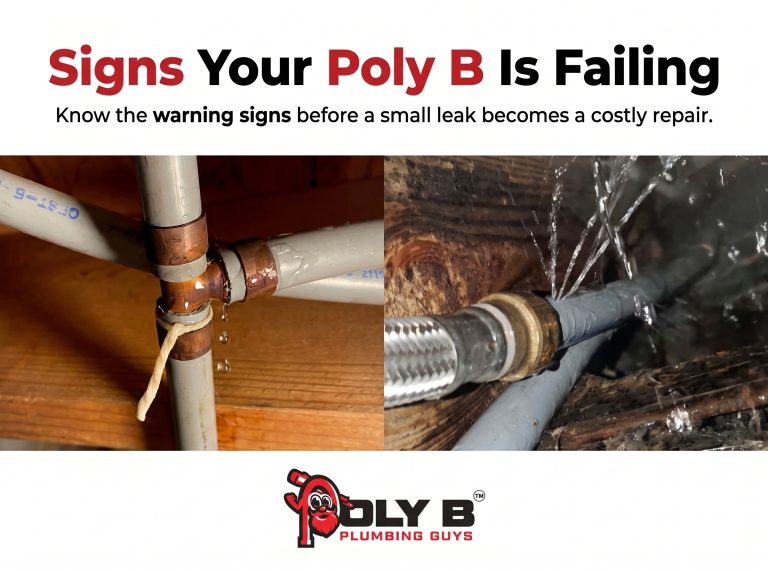
Poly B failure is not a question of if — for most homes plumbed with grey polybutylene pipe between the late 1970s and late 1990s, it is a question of when. Thousands of Alberta and BC homes still carry this discontinued pipe, and every year more of them see the ceiling stains, pinhole leaks, and burst fittings that define a poly B failure.
This guide covers what poly B failure looks like, why it happens, what it costs, what to do in the first ten minutes of a leak, and how the permanent fix works. Not sure your home even has this pipe? Start with how to identify Poly B pipes.
25-Year Warranty · Fixed Price · 100% Poly B Replacement Guaranteed · Fully Protected Home During Work · Certified Poly B Specialists ·
What Is Poly B Failure — and Why Does It Happen?
Polybutylene was installed in several million North American homes between roughly 1978 and 1997 before being removed from Canadian building codes in 2005. According to the Wikipedia entry on polybutylene, chlorine and chloramine in treated municipal water attack the pipe’s internal chemical structure — which is why a poly B failure so often starts on the inside: the pipe can look fine while the inner wall is already flaking apart.
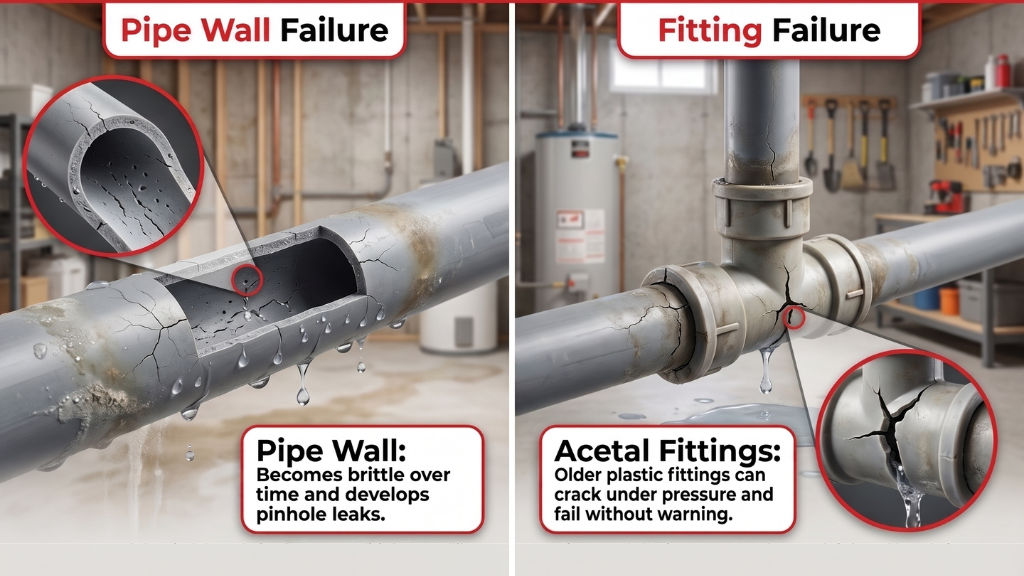
Poly B failure shows up in two places: the pipe wall, which turns brittle and develops pinholes, and the fittings — especially older acetal (plastic) fittings that crack under stress. Because the degradation is chemical and cumulative, a poly B failure can strike a system that has never leaked before. For a full background on the material, see what is Poly B piping.
7 Signs of Poly B Failure in Your Home
Most homeowners discover poly B failure through one of these warning signs. One is worth investigating; two or more mean active deterioration.
1. Discoloured or odd-tasting water
Flaking pipe material and degrading fittings can change the taste or colour of your tap water — often the earliest hint of internal poly B failure.
2. Brittle, flaking, or discoloured pipe
Healthy plastic pipe flexes. Poly B that snaps, crumbles, or shows chalky white stress lines at bends is in the late stages of failure.
3. Pinhole leaks
Tiny sprays or weeps along a straight run of pipe are classic poly B failure — the chlorine damage has finally worked through the wall.
4. Stains on ceilings and walls
Brown rings, bubbling paint, or soft drywall usually mean a slow hidden leak above. With Poly B, small hidden leaks rarely stay small.
5. Falling water pressure
A gradual pressure drop at fixtures can indicate internal scaling and constriction as the pipe degrades from the inside.
6. A water meter that never stops
Shut off every fixture, then check your meter. If it still creeps, water is escaping somewhere — and in a Poly B home, a hidden poly B failure is the first suspect.
7. Repeated leaks at fittings
One repaired joint followed by another failing months later is the signature pattern of system-wide poly B failure, not bad luck. More clues are covered in signs your home used Poly B during construction.
What Does a Poly B Failure Actually Cost?
The pipe repair itself is usually the cheapest part. The real cost of a poly B failure is the water damage: soaked drywall, ruined flooring, cabinetry, mold remediation, and weeks of disruption. The Insurance Bureau of Canada notes that standard home policies typically cover sudden, accidental water damage from indoor plumbing — but some Alberta and BC insurers now question polybutylene, raise premiums, or restrict coverage on homes that still have it. We break that down in Poly B and insurance in Alberta and BC.
Compare that with planned replacement at a fixed price, on your schedule, before a poly B failure picks the timing for you. Our Poly B replacement cost guide explains what drives the price of a full repipe.
The First 10 Minutes of a Poly B Leak
When a poly B failure turns into an active leak, the first ten minutes decide whether you face a repair or a restoration project. Do this, in order:
1. Shut off the main water valve. Usually in the basement or utility room where the line enters the house — everyone at home should know where it is before a poly B failure ever happens. 2. Open the lowest tap in the house to drain pressure out of the lines and slow the leak. 3. Kill power to affected areas at the breaker panel if water is near outlets, fixtures, or ceiling lights. 4. Move belongings and catch water with buckets, towels, and plastic sheeting. 5. Photograph everything — the leak, the damage, the pipe — before cleanup, for your insurer. 6. Call your insurance company and a Poly B specialist. Patching one joint on a failing system only buys time until the next poly B failure.
The Permanent Fix: Remove, Replace, Restore
Spot repairs do not cure poly B failure, because the entire system is degrading at the same rate. The only permanent answer is complete replacement. Our Red Seal certified team follows a Remove Replace Restore process: we open precise drywall access points, completely remove every length of Poly B, install a full PEX repipe, then repair the drywall and match your paint so your home looks untouched. See why PEX is the modern standard in Poly B vs PEX, and everything included on our services page.
Every project comes with a fixed-price quote before work begins, a 25-year warranty, and an official completion certificate you can show your insurer or a future buyer as proof the poly B failure risk is gone. Homeowners across Western Canada have rated the results at 4.9 stars on Google — you can learn more about us here.
Stopping Poly B Failure Across Alberta and BC
We replace failing polybutylene in Calgary, Edmonton, Red Deer and Central Alberta, the Vancouver Lower Mainland and Fraser Valley, and Kelowna and the Okanagan. Wherever you are, the process, warranty, and fixed pricing are the same.
Poly B Failure: Frequently Asked Questions
How long does Poly B last?
Most industry sources put the practical lifespan at roughly 25 to 40 years, depending on water chemistry, pressure, and installation quality. Installation in Canada ended in the late 1990s, so nearly every remaining system is at or beyond that window — which is why poly B failure is accelerating, not tapering off.
Does Poly B need replacing if it has never leaked?
A dry history is not a clean bill of health. Chlorine degradation happens inside the pipe wall, so a system can look and perform perfectly right up until the first poly B failure. Replacing on your schedule is cheaper and calmer than replacing after a flood.
Is polybutylene piping a deal breaker when buying a home?
It does not have to be — but it should change the deal. Budget for full replacement, negotiate accordingly, and confirm the insurer will cover the home. A documented repipe with a completion certificate removes the issue for resale.
Can just the failed section be repaired?
Mechanically, yes — a plumber can cut out a leaking section. But because the whole system degrades together, a patch treats one symptom of poly B failure while every other metre of pipe keeps aging. Most homeowners who patch end up paying twice. More answers on our FAQs page.
Get Ahead of Poly B Failure — Fixed-Price Quote
Seen any of the signs above — or simply know the grey pipe is back there? Get a fixed-price quote now, before it becomes an emergency. It takes two minutes.
Prefer to talk? Calgary (403) 257-6934 · Central Alberta (403) 880-3541 · Edmonton (780) 993-5325 · Vancouver (604) 616-0847 · Kelowna 250-888-9215.