
Why Poly B Removal Is Back on Every Alberta Homeowner’s List
Poly B removal has moved from a “someday” renovation to an urgent one for Alberta homeowners. Polybutylene piping — the grey flexible plastic installed in hundreds of thousands of Calgary, Edmonton and Red Deer homes between 1985 and 1998 — is now the single most common reason insurers issue non-renewal notices in Western Canada, and it remains one of the leading causes of residential water damage. If your home was built or replumbed in that window and has never been repiped, this guide covers what removing Poly B involves, what a poly B removal inspection looks like, what it costs in 2026, and which myths are still costing homeowners money.
The Poly B Plumbing Guys provide complete polybutylene pipe removal and PEX replacement across Calgary, Edmonton, Central Alberta and BC. Every project is handled by Red Seal certified plumbers using our Remove–Replace–Restore process: old pipes out, new PEX in, drywall patched, paint finished — all under one fixed-price quote. Edmonton and capital-region homeowners can find local pricing, permit details and project timelines on our Poly B removal and replacement in Edmonton page.
What Is Poly B and Why Does It Fail?
Polybutylene (stamped PB2110 or CSA-B 137.8 on the pipe) was marketed as a cheaper, easier-to-install alternative to copper. It was removed from the National Plumbing Code of Canada in 2005, and no new installations have been permitted since.
The problem is chemical, not mechanical. Chlorine and other oxidants in municipally treated water attack the pipe wall from the inside, creating micro-fractures that grow into pinhole leaks, split fittings and full-line failures. Because the damage starts on the interior surface, a pipe can look perfect from the outside and be within months of failing. The poly B failure rate climbs sharply once the material passes 25 years of service — which now describes every Poly B system in Alberta.
Alberta adds two accelerants. Freeze-thaw cycling stresses brittle, aged plastic at every fitting, and water chemistry varies enough between Calgary, Edmonton and Red Deer that degradation patterns are unpredictable from one municipality to the next.
Does Your Home Have It? Three Quick Checks
Look in the mechanical room, under sinks, beside the hot water tank and along exposed basement ceilings. Poly B is grey (occasionally light blue), flexible, roughly 12–19 mm in diameter, and often connected with copper crimp rings or grey plastic fittings. The “PB2110” stamp confirms it. If your home dates from 1985–1998 and has never been repiped, assume it is there until proven otherwise. For a full walkthrough, see our guide on how to identify Poly B pipes in your home.
What a Poly B Removal Inspection Looks Like
Every removal starts with a whole-home inspection. Its purpose is scope, not sales: mapping every metre of polybutylene so the quote is fixed and nothing is discovered halfway through the job.
- Property history. Construction date, any prior leaks or partial repairs, and current plumbing materials.
- Visual inspection of exposed runs. Basement, utility room and under-sink piping is checked for discolouration, flaking, scaling and bulging at fittings.
- Hidden-pipe assessment. Infrared cameras and moisture meters locate concealed runs and any active seepage without opening walls.
- Pressure and flow testing. Fixture-by-fixture testing flags degraded sections and restrictions.
- Fittings and connections. Original acetal (plastic) fittings and crimp rings are the most common failure points and are inspected individually.
- Written report and fixed quote. You receive a map of every Poly B run, the PEX-A or PEX-B recommendation for your home, and a single all-in price.
The Poly B Removal Process: Remove, Replace, Restore
Professional Poly B pipe removal means replacing every metre of polybutylene in the house — not the sections that have already failed. Here is how the work flows on a typical Alberta detached home.
Remove
Water is shut off and the system drained. The plumber opens the minimum number of access points needed to reach each run, disconnects fixtures where required, and cuts out the old pipe systematically from the main to every branch. Removed polybutylene is bagged and disposed of according to municipal rules.
Replace
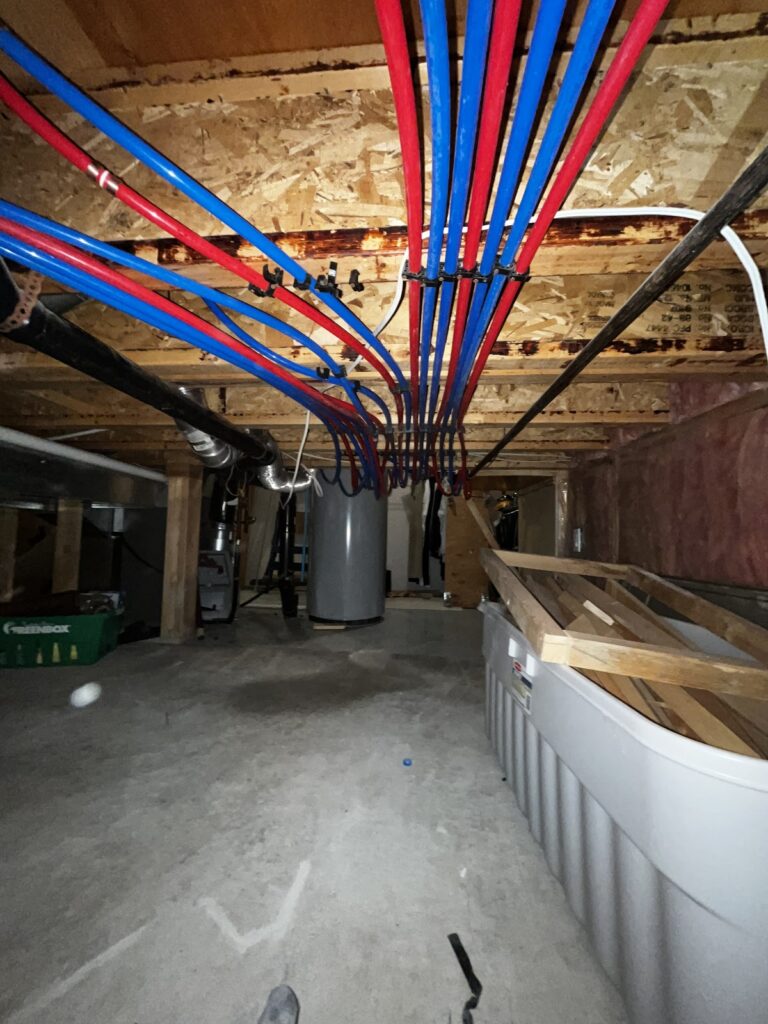
New PEX (cross-linked polyethylene) is routed through the same access points, using brass fittings rated for Alberta’s water chemistry. We specify PEX-A for most Calgary and Edmonton homes because it is more flexible and tolerates freeze-thaw cycles better than PEX-B. The complete system is pressure-tested before a single wall is closed, and the municipal permit inspection is booked.
Restore
Drywall is patched, mudded and textured to match, then painted. Because our plumbers, drywallers and painters are one crew, there is no second contractor to coordinate and no gap between “plumbing done” and “house back to normal.” You receive a Certificate of Completion and a closed permit — the two documents insurers and buyers ask for.
Timeline: plumbing takes one to two days on most detached homes, followed by one to two days of drywall, texture and paint. From quote to closed permit, expect 10 to 14 days. For a step-by-step breakdown of the removal itself, read how to remove Poly B plumbing from your home: the 10-step process.
Poly B Removal Cost in 2026
Poly B removal cost depends on home size and pipe run length, number of bathrooms and fixtures, whether the basement is finished, storey count, and the fitting types in place. The ranges below reflect our current fixed-price quotes and include removal, PEX installation with brass fittings, pressure testing, permit, drywall restoration and cleanup.
| Home type | Calgary & Edmonton | Vancouver & Lower Mainland |
|---|---|---|
| Condo / apartment (under 1,000 sq ft) | $4,500 – $6,500 | $5,500 – $8,000 |
| Bungalow / townhome (1,000 – 1,400 sq ft) | $6,500 – $9,000 | $8,000 – $12,000 |
| Standard detached (1,400 – 2,200 sq ft) | $8,500 – $12,500 | $11,000 – $16,000 |
| Large home / finished basement (2,200+ sq ft) | $12,000 – $16,000+ | $15,000 – $20,000+ |
We do not bill hourly. If we open a wall and find polybutylene that was not visible during the walkthrough, we replace it — no change orders. A fair Poly B removal quote is always fixed-price, names the replacement material, includes drywall restoration, and confirms full removal rather than partial. See our Poly B FAQ for the full pricing breakdown by city.
Insurance, Permits and Resale
Insurance. Major Canadian insurers — including Intact, Wawanesa and Economical — now issue non-renewal notices and mid-term cancellations for homes with confirmed polybutylene. Proactive replacement is treated as maintenance and is not covered, but completing it is the only remedy insurers accept, and partial replacement does not qualify. Full details are in our article on Poly B pipes and home insurance in Alberta.
Permits. A plumbing permit is required in Calgary, Edmonton and most Alberta and BC municipalities. We file the application, book the inspection and close the permit as part of every job. Unpermitted repiping can void insurance and surfaces at resale.
Resale. Poly B is now a standard home-inspection flag. Buyers negotiate the replacement cost off the price — or walk — and many mortgage lenders attach plumbing conditions. Completing removal before listing removes the issue, restores full insurability and gives you a Certificate of Completion to hand to the buyer’s agent.
5 Myths About Poly B Removal That Cost Homeowners Money
Despite the well-documented failure rate of polybutylene piping, several misconceptions continue to delay necessary replacements. Here are the five most common — and the reality behind each.
Myth 1: Poly B pipes are safe until they leak
This is the most dangerous assumption homeowners make. Polybutylene does not fail suddenly — it degrades gradually as chlorine and oxidants in treated water attack the pipe wall from the inside. By the time a visible leak appears, the surrounding sections are already compromised. Waiting for a leak means waiting for the damage to reach your drywall, insulation and subfloor, turning a planned replacement into an emergency remediation.
Myth 2: Insurance will cover Poly B failures
Some insurers refuse to write new policies on homes with Poly B; others require proof of full replacement before renewing. In Calgary, insurance non-renewal is the single most common reason homeowners call us. The cost of proactive removal is a fraction of an uninsured water-damage claim paid out of pocket.
Myth 3: Hidden leaks are not a serious risk
Visible leaks are a small fraction of the problem. Most polybutylene failures start as slow seepage behind finished walls, under floors or above ceilings, creating ideal conditions for mould, framing rot and degraded insulation long before anything shows. Our inspection uses pressure testing and infrared mapping specifically to find the runs you cannot see.
Myth 4: Replacing only the damaged sections is enough
If one section has failed, every other section — same material, same water chemistry, same age — is on the same timeline. Spot repairs leave weakened pipe behind your walls, reset none of the risk, and do not satisfy insurers. Every project we take on is a complete removal; we do not patch.
Myth 5: DIY Poly B replacement saves money
Repiping means opening walls, rerouting supply lines, making code-compliant crimp or expansion connections, passing a permit inspection, and restoring finished surfaces. Improper connections can take months to show, and unpermitted work can void insurance and create problems at resale. Red Seal plumbers, a pressure test and a closed permit are what hold up to inspectors and insurers.
What Happens to the Old Pipe?
Polybutylene is not biodegradable, and a whole-home removal produces a surprising volume of it. We separate removed pipe and brass fittings from drywall waste, route the brass to metal recycling, and dispose of the plastic through municipal programs rather than general landfill where a stream exists. PEX, the replacement, has a service life measured in decades and a lower-energy manufacturing footprint than copper — one reason it has become the standard repipe material across Alberta.
A Calgary Homeowner’s Experience
Gerry, a Calgary homeowner, booked his Poly B removal after several friends dealt with leaks and floods. “The cost of replacing an entire home’s infrastructure due to a flood is immense compared to simply replacing Poly B pipes before a problem occurs,” he told us. His priority was avoiding a plumber who would “replace the Poly B and leave us with a big mess.” The plumber “cut all the holes where he needed to without making more cuts than necessary,” the drywaller “went above and beyond the original scope,” and the painters “were in and out within two hours.” Start to finish, the project took just over two weeks, and Gerry’s home was fully insurable again.
Poly B Removal FAQ
Is Poly B removal necessary if my pipes aren’t leaking?
Yes. Polybutylene degrades from the inside out, so there is no external way to assess its condition. Every Poly B system in Alberta is now past 25 years of service, and insurers increasingly require replacement regardless of leak history.
How much does Poly B removal cost in Calgary?
In 2026, fixed-price Poly B removal in Calgary runs from about $4,500 for a small condo to $16,000+ for a large home with a finished basement. Most standard detached homes fall between $8,500 and $12,500, including PEX, permit and drywall restoration.
How long does Poly B removal take?
One to two days for plumbing, then one to two days for drywall, texture and paint on most detached homes. The full process from quote to closed permit typically spans 10 to 14 days.
Will my home insurance pay for Poly B removal?
No. Proactive replacement is treated as a maintenance cost. Completing it, however, is what restores or preserves coverage.
Can I replace just the damaged section of Poly B?
You can, but it will not resolve the risk or satisfy an insurer. All sections share the same age and water exposure, and insurers require confirmation that all polybutylene has been removed.
What is Poly B replaced with?
PEX (cross-linked polyethylene) with brass fittings. We recommend PEX-A for Calgary and Edmonton homes because it handles freeze-thaw cycles better than PEX-B.
Get a Free Poly B Removal Assessment
If your home was built between 1985 and 1998, your plumbing likely contains polybutylene. Whether you are responding to an insurance notice, preparing to sell, or simply want the risk gone, we can help. Request a fixed-price quote or call us directly: Calgary (403) 257-6934 · Edmonton (780) 993-5325 · Central Alberta (403) 880-3541 · Vancouver (604) 616-0847 · Kelowna (250) 888-9215. Service pages: Calgary, Edmonton, Central Alberta, Vancouver, Kelowna.